Executive Summary: The Paradigm Shift
TL;DR — The 30-Second Brief
- The Myth: “Autos are weak, low-yield plants for beginners.”
- The Reality: 2025 genetics (“Super Autos”) consistently hit 25–30% THC and can yield 200g+ per plant.
- The Mechanism: They run on an “Internal Clock,” not a light schedule. You cannot clone time.
- The Key: Treat light as food (DLI), not a signal.
- The Rule: Do not starve them. The “Quarter Strength Nutrient” rule is dead.
For nearly two decades, “Autoflower” was a dirty word in serious cultivation circles. If you were growing Cannabis ruderalis hybrids in 2010, you were likely hiding a stunted, leafy “Lowryder” in a PC tower case, hoping for a quarter-ounce of 12% THC flower. It was the “training wheels” of the industry—a biological novelty unworthy of commercial canopy space. That era is dead.
As we stand in 2025, we are witnessing a horticultural revolution. Through rigorous selective breeding programs reaching F4 and F5 generations, the “Super Auto” has emerged. These are not the unstable ditch weeds of the past; they are genetic powerhouses that rival—and often outperform—elite photoperiod clones in terms of terpene complexity and cannabinoid production.
We are no longer sacrificing quality for speed.
We are leveraging evolutionary biology to achieve both.
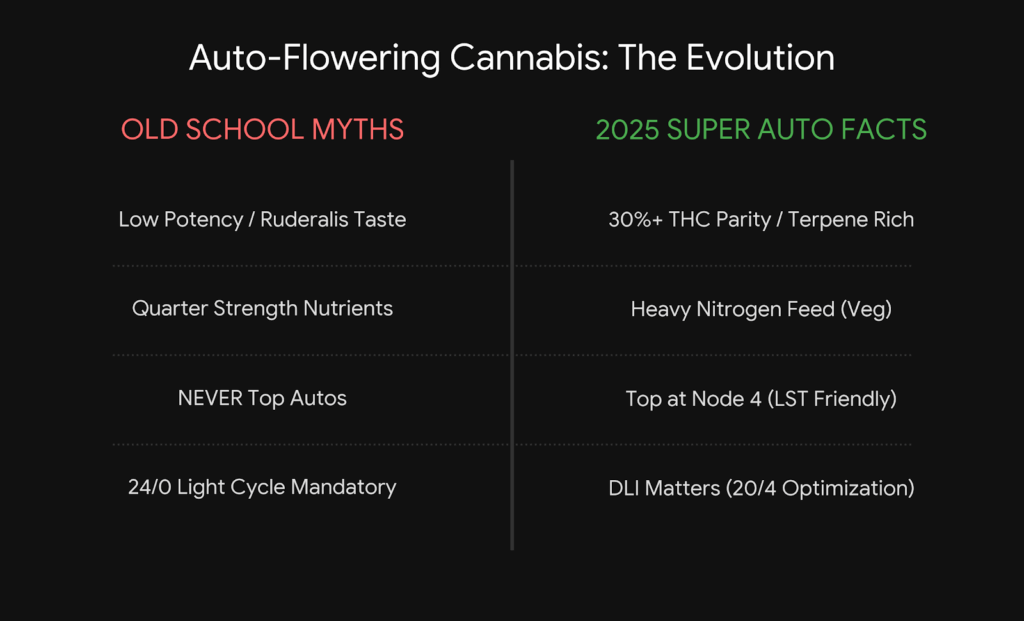
| Feature | Legacy Logic (The 2010s) | 2025 Scientific Consensus |
|---|---|---|
| Potency | “Autos are weak. You sacrifice THC for speed.” | Parity Achieved. Top cultivars consistently test at 26–30% THC. |
| Nutrients | “Starve them. Use 1/4 strength.” | Feed them. Rapid biomass production requires heavy Nitrogen (EC 1.4–1.8). |
| Training | “Never top an Auto.” | Top once. Vigorous genetics benefit from topping at Node 4. |
| Lighting | “Just leave them on 24/0.” | DLI Management. 20/4 is the metabolic “sweet spot” (40–45 DLI). |
| Transplant | “Never transplant.” | Transplant with care. Proper timing can stimulate root branching. |
The Science: Genetics & Physiology
The Botanical Survivor: From Siberian Steppes to Your Tent
To truly master the modern autoflower, you must understand the “Jack Herer” element of its history—the botanical crusade for survival.
Cannabis ruderalis is the scrappy, overlooked cousin of the majestic Sativa and the stout Indica. While its cousins were enjoying the warm, long summers of India and the Hindu Kush, Ruderalis was exiled to the unforgiving steppes of Central Russia and Siberia.
In these harsh latitudes, the winter comes fast and it kills without mercy. A plant waiting for the “photoperiod” signal (the days getting shorter) would simply freeze to death before it could reproduce. To survive, Ruderalis evolved a radical biological hack: Day-Neutrality.
It stopped listening to the sun and started listening to its own internal metabolic clock. Roughly 3–4 weeks after germination, regardless of whether it is receiving 24 hours of light or 6, the Ruderalis plant triggers flowering. This was not a choice; it was an evolutionary imperative. It is this ancient survival mechanism—forged in the ice of the Paleolithic era—that we are now harnessing to harvest 30% THC crops in 75 days.
The “Internal Clock” & The Cloning Problem
This evolutionary trait is what separates “growing” an auto from “growing” a photoperiod.
- Photoperiods are controlled by the operator. You can veg a Mother Plant for 10 years if you keep the lights on 18/6. You are the god of its timeline.
- Autoflowers are controlled by the plant. The moment that seed cracks, a countdown timer starts. You cannot pause it. You cannot rewind it.
This is why you generally cannot clone an autoflower. A clone is a biological copy that shares the physiological age of the mother.
- Scenario: You take a cutting from a 4-week-old Auto.
- Result: That cutting “thinks” it is 4 weeks old. Even if it roots (which takes 10 days), it will immediately try to flower while it is only 2 inches tall. You have created a bonsai, not a crop.
The F-Generation: Why “Stability” is the Buzzword of 2025
In the “Wild West” days of 2012, growers bought “Auto” seeds that turned out to be photoperiods, or “Dwarfs” that grew 6 feet tall. This was due to F1 Instability.
- F1 (First Filial Generation): The first cross between a Photo and an Auto. These are vigorous but unstable. Only a percentage will autoflower.
- F4/F5 (Artisanal Quality): This is where the magic happens in 2025. Breeders like Mephisto Genetics and Night Owl have worked these lines for 4 or 5 generations, locking in the recessive autoflowering trait and stabilizing the phenotype.
The Pro Tip: Stop buying “White Label” F1 seeds. Look for breeders who explicitly state the “F-generation” of their stock. You are paying for consistency.
The Environment: Lighting & The DLI Revolution
Stop Counting Hours, Start Counting Photons
If you are still asking “Should I run 18/6 or 24/0?” you are asking the wrong question.
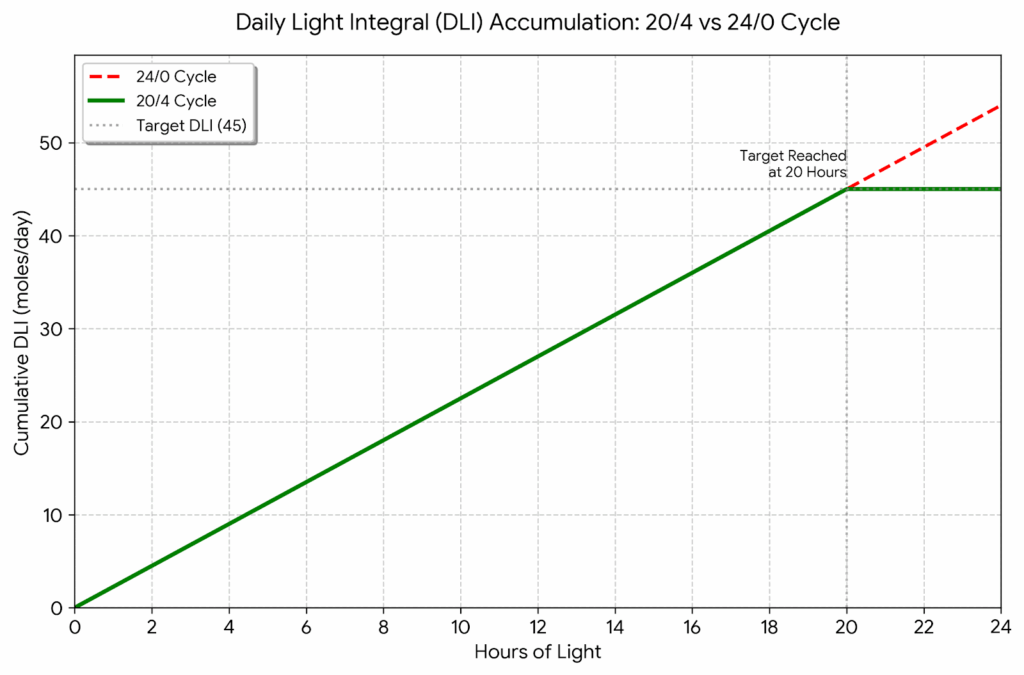
The plant does not care about the clock; it cares about the Daily Light Integral (DLI).
Think of your plant as a solar panel with a battery.
- PPFD (Photosynthetic Photon Flux Density): The intensity of the light hitting the canopy right now (like the flow of water from a hose).
- DLI: The total amount of light the plant receives in a 24-hour period (the bucket of water you filled up).
Because Autoflowers do not need darkness to flower, we have a unique advantage: we can leave the “hose” on longer. This allows us to hit the same DLI with a cheaper, less powerful light by running it for more hours.
The DLI Mathematics
Here is the formula every serious operator needs to memorize. This is how you optimize your electricity bill (ROI):
$$DLI = PPFD \times 0.0036 \times Hours$$
- The Sweet Spot: Cannabis reaches photosynthetic saturation (without CO2) around 40–50 DLI.
The 18/6 vs. 24/0 Verdict:
- Option A (24/0): You can run your lights at a lower intensity (lower heat, better efficiency) because you have 24 hours to fill the bucket.
- Target PPFD: ~460 µmol/s/m²
- Option B (20/4): The 2025 “Gold Standard.” Many master growers believe the 4-hour dark period allows for critical root respiration and metabolic rest, while still providing a massive DLI.
- Target PPFD: ~550–600 µmol/s/m²
Editor’s Command: Buy a lux meter or use a PAR meter app (like Photone) and calibrate it. Guessing your light intensity is the fastest way to stunt an auto.
Soil & Nutrition: Debunking the Starvation Myth
The Nitrogen Fallacy
Legacy forums are filled with bad advice: “Autos are sensitive! Feed them quarter strength! Treat them like seedlings!”
If you treat a modern Super Auto like a seedling, you will get a seedling-sized yield.
The Biology:
A modern Auto like Frostbanger or Banana Jealousy has to build an entire root system, stalk, and branch structure in 35 days. That is an explosive rate of vegetative growth.
- Nitrogen (N) is the building block of chlorophyll and plant tissue.
- The Mistake: Growers read “sensitive” and underfeed Nitrogen in weeks 2–5.
- The Result: The plant yellows out (chlorosis) just as it hits the pre-flower stretch. It cannabalizes its own lower leaves to survive. You lose the solar panels you need for big buds.
The 2025 Protocol:
Start light in Week 1, but ramp up aggressively. By Week 3, your Auto should be eating a full Veg regimen (EC 1.2–1.4). Do not cut Nitrogen when you see the first white pistils. The plant still has to double in size during the stretch. Keep the Nitrogen flowing until vertical growth stops.
The “Living Soil” Approach (The Organic Path)
For those who want the highest terpene profiles without mixing bottles every day, Living Soil is the superior method. Because the Auto cycle is so short (75–90 days), you often don’t have time to fix a pH lockout caused by salt nutrients. Biology buffers the mistakes.
The “Layer Cake” Method: Autos have taproots that dive deep fast.
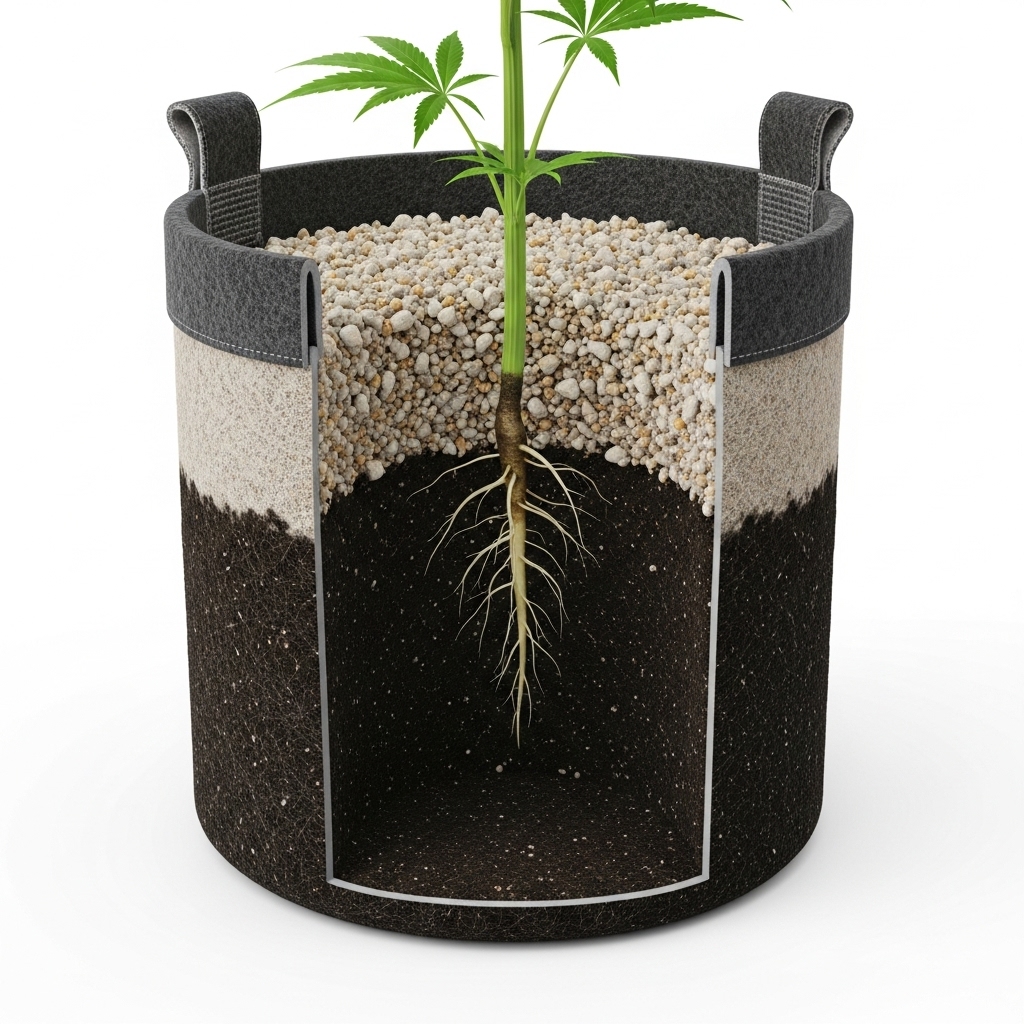
Figure 3: The “Layer Cake” Method. By placing nutrient-dense super soil only in the bottom third, you protect the seedling while ensuring a heavy food source is available exactly when the taproot dives deep during the flowering stretch.
- Bottom 1/3 of Pot: “Super Soil” (Hot, nutrient-rich compost, amendments, fish bone meal).
- Top 2/3 of Pot: Light Mix (Peat/Perlite with worm castings but low nutrients).
Why this works: The seedling starts in the safe, light mix. By the time it is hungry (Week 3–4), its taproot hits the “Hot Layer” at the bottom, delivering a timed-release nutrient bomb exactly when the flowering stretch begins. No bottles, no burn.
Hydroponics & Coco Coir (The Yield Path)
If your goal is maximum biomass (ROI), sterile mediums like Coco Coir or DWC (Deep Water Culture) are king.
- The Engine: In hydro, the roots are constantly bathed in oxygen and nutrients. An Auto in DWC can grow 30% larger than in soil.
- The CalMag Warning: Under powerful LED lights, Autos in Coco have an insatiable appetite for Calcium and Magnesium. If you are growing in Coco, CalMag is not a supplement; it is a base nutrient. Use it from Day 1.
Genetic Selection: The 2025 Market Leaders
If you buy cheap genetics, you will get cheap results. In the autoflower game, the “breeder” is more important than the “strain name.”
In the legacy era, the market was flooded with unstable F1 hybrids—seeds that were only one generation removed from a wild Ruderalis. These plants were unpredictable; one seed might grow six inches tall, while its sister grew six feet.
Today, we demand Phenotypic Stability. This is achieved by “working the line” to F4 or F5 generations (breeding the plant with itself for 4-5 generations) to lock in the autoflowering trait and the cannabinoid profile.
Auditing the Old Guard
Stop buying strains like “Dwarf Low Flyer” or generic “Auto Critical.” These are relics. They were bred for stealth, not performance. In 2025, you want “Super Autos”—genetics bred for potency, terpenes, and yield.
The New Titans: Who to Buy From
Based on current stability data and terpene analysis, these are the breeders setting the standard:
- The Artisanal Leaders (Flavor/Frost):
- Mephisto Genetics: Widely recognized as the gold standard for small-batch, F4+ genetics. Their “Illuminautos” and “Artisanal” lines define the top shelf.
- Night Owl Seeds: Founded by a former Mephisto breeder, they specialize in unique photoperiod-to-auto conversions like Sourdelica (a rare Sativa auto testing over 23% THC).
- The Commercial Yielders (Scale/Potency):
- Fast Buds: Once a volume seller, they have drastically improved quality. Strains like Frostbanger Auto (26.7% THC) are winning cups globally.
- Ethos Genetics: They brought “boutique” photoperiod genetics (like Mandarin Cookies) into the auto format. Their Banana Jealousy Auto is a known heavy yielder.
2025 Strain Recommendations by Category
- Highest Potency: Mendo Breath Auto (Atlas Seed) – Lab tested at 30.33% THC.
- Best Outdoor Resilience: Pig Candy Auto (Twenty20 Mendocino) – Bred specifically for mold resistance in variable climates.
- Best Terpenes: Mango Runtz (Mephisto Genetics) – Winner of “Best New Auto 2025”.
The Week-by-Week Execution Guide
You cannot “wing it” with an auto. The timeline is fixed. This is your battle plan.
Phase 1: The Seedling (Days 1–14)
The Goal: Root establishment. The Danger: Overwatering (Dampening Off).
- Environment: High Humidity (65–70% RH). Temp: 24–26°C.
- Light: Target DLI 10–15. (Approx. 150–200 PPFD on a 20/4 schedule) .
- Action: Plant directly into the final pot or use an air-pruning nursery bag. Do NOT feed nutrients if using soil. If using Coco, feed very light (EC 0.4).
- Critical Note: The taproot is diving down. If you overwater, you suffocate it, and the plant will stunt permanently.
Phase 2: The Vegetative Explosion (Days 15–35)
The Goal: Building the solar panels (leaves) and structure. The Danger: Missing the “Topping Window.”
- Environment: Humidity 55–60%.
- Light: Ramp DLI to 30–35.
- Nutrients: This is the hunger phase. If not in Super Soil, ramp EC to 1.2+. This is where you need Nitrogen.
- Decision Point (Day 18–20): Count the nodes. If the plant has 4 nodes and is growing fast, TOP IT. If it is small or struggling, do not cut.
Phase 3: The Pre-Flower Stretch (Days 35–55)
The Goal: Vertical growth and stacking sites. The Danger: The “Transition” Nutrient Error.
- Observation: You will see white pistils (hairs) at the nodes. The plant will double in height.
- Nutrients: DO NOT switch to Bloom nutrients yet. The plant needs Nitrogen to build that stretching stem. Continue feeding Veg/Transition nutrients until vertical growth stops.
- Light: Maximum power. Target DLI 40–45.
Phase 4: Stacking & Ripening (Days 56–Harvest)
The Goal: Bud density and trichome maturation. The Danger: Mold and Bud Rot.
- Environment: Drop Humidity to 40–50% immediately. Large auto colas are dense and prone to rot.
- Nutrients: Switch to Bloom (High P-K). Taper off Nitrogen.
- Timing: Ignore the seed pack. If it says “8 weeks,” expect 10–12 weeks.
Advanced Training: Topping vs. LST
Shattering the “Don’t Top” Dogma
In 2010, the advice was “Never top an auto.” That advice is now obsolete for modern genetics.
The Science: Topping (cutting the main stem) breaks apical dominance, redistributing growth hormones (auxins) to the side branches to create a flat canopy of multiple main colas. The Rule: You can top a “Super Auto” ONCE at the 4th Node, provided the plant is healthy and vigorous.
- Too Early (Node 3): Root system isn’t ready. Shock risk high.
- Too Late (Node 5+): Plant is already transitioning to flower. You are cutting off the main bud.
Low Stress Training (LST)
If you are a beginner, or if your plant is looking slow, stick to LST. The Method: Gently bend the main stem down and tie it to the side of the pot. This exposes the lower bud sites to the light without the stress of cutting tissue.
- Timing: Start LST around Week 3 or 4. Do not try to train once the stems turn woody (lignify) during the stretch.
Harvest & Curing: The Truth About Timing
The “Breeder Timeline” Lie
Marketing departments love to print “Ready in 60 Days!” on the pack.
The Reality: High-quality phenotypes typically require 75–95 days to reach peak cannabinoid maturity. Harvesting at day 60 usually means sacrificing 20% of your weight and 30% of your potency.
The Trichome Standard
There is only one way to know when to chop: The Trichomes. Get a 60x loupe. Look at the calyxes (the pods), not the sugar leaves.
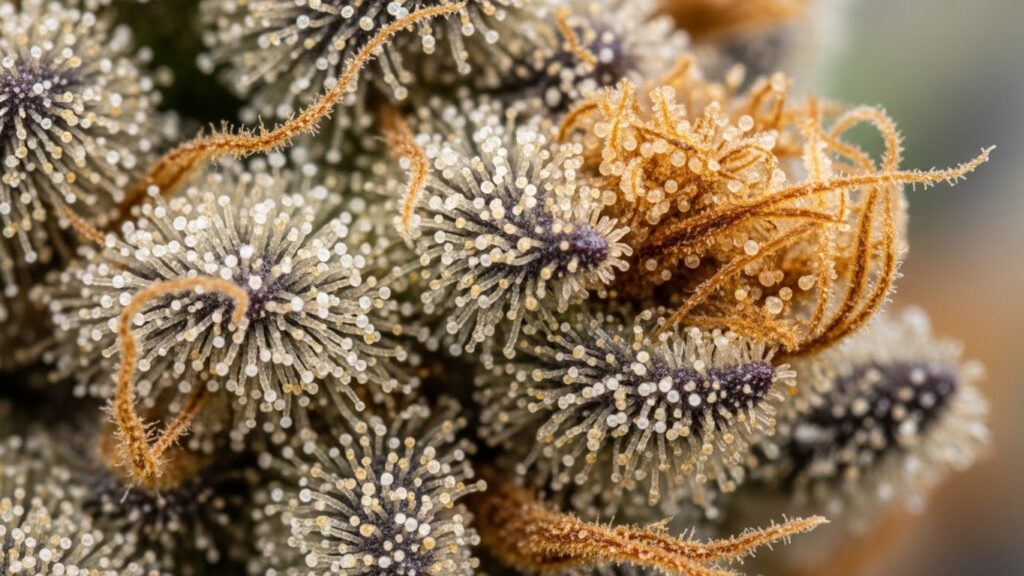
- Clear: Immature. Do not harvest.
- Cloudy/Milky: Peak THC. The psychoactive ceiling.
- Amber: Degraded THC (CBN). Sedative/Couch-lock effects.
- The Target: Most growers aim for 100% Cloudy with 10–15% Amber for a balanced effect.
The Pistil Trap (Foxtailing)
Do not judge ripeness by the white hairs (pistils). Autoflowers are prone to “foxtailing” (sprouting new white hairs late in flower) due to heat stress or genetics. If your trichomes are amber but you see new white hairs, ignore the hairs and harvest. The trichomes are the only truth.
Troubleshooting & FAQ
The “Runt” Phenomenon
Sometimes, despite perfect care, you get a “runt.” This is a genetic anomaly where the internal clock triggers flowering instantly (dwarfism).
- The Call: If a plant is significantly behind its sisters by Day 21, cull it. It will not recover, and it is wasting light and space.
Stunted Growth
- Cause: 90% of stunting is caused by overwatering in the first 10 days or cold temperatures.
- Solution: You cannot fix a stunted auto like you can a photoperiod. Raise the temperature, let the pot dry out, and accept a smaller yield. Learn for the next run.
FAQ: The Modern Grower’s Queries
Technically yes, but practically no. A clone retains the physiological age of the mother. If you clone a 4-week-old auto, the clone will try to flower immediately, resulting in a tiny, useless plant.
Per plant? Usually yes. Per year? Often no. Because autos are faster (4–5 harvests per year) and require no separate veg tent, the annual yield per square meter is often higher. Plus, deep water culture (DWC) autos can yield 200g+ per plant.
Not necessarily. 20/4 is the “efficiency sweet spot.” It gives you 90% of the growth potential while saving 4 hours of electricity and giving the plant a metabolic rest period.
The old rule was “never transplant.” The new rule is “transplant carefully.” If you time it right (before the taproot circles the bottom) and use mycorrhizae to reduce shock, transplanting works fine. However, planting directly into the final pot remains the safest method for beginners.